- McKinsey Solve is currently reported to include three games: Redrock Study, The Sea Wolf and Sustainable Futures Lab. Your invitation states the length of your assessment; candidates report versions of 85 and 95 minutes, and the difference is the Lab.
- Your first timed run of each game is a diagnosis, not a verdict. Its job is to show where you lose time and points.
- After each run, choose one fix, practise it, then play again and compare the same step. A few reviewed runs are worth more than many rushed ones.
- Fit the plan to your days. With a few days, work on your weakest game and on pacing; with a week or more, alternate full runs and targeted practice; with three weeks, start case preparation too.
- On test day the official rules come first: untimed tutorials, no applications, websites, AI tools or prepared notes, and technical problems reported while they happen.
What a good McKinsey Solve plan looks like
A good plan is a loop, not a list of runs. You play a game under time, find the one step that cost you most, practise that step on its own, and play again to check that it improved. Everything else in this article, from the calendars to the test-day checklist, is a way of fitting that loop into the time between your invitation and your deadline.
The loop matters because McKinsey Solve rewards habits more than knowledge. The maths is simple, there is no business content, and the scenarios change for every candidate, so there are no answers to memorise. What you can build is a reliable way of working under a clock, and that only improves when you know exactly what went wrong last time.
CasePreparation is independent and not affiliated with McKinsey & Company. The game names and timings below come from candidate reports, and your invitation and the instructions inside the assessment always take precedence.
Start from your invitation and the three games
McKinsey's FAQ says that the length of the assessment is outlined in your invitation email, and it does not publish the length of each game. That makes the invitation the first thing to read when you plan, because it tells you how much time you will spend in front of the screen and, according to candidate reports, which version of the Lab you are likely to meet.
The three games in brief
| Game | What you do | Reported time |
|---|---|---|
| Redrock Study | Research a question, save the relevant data in a journal, calculate, complete a short report, then answer six short cases | About 35 minutes |
| The Sea Wolf | Choose microbes for three ocean sites so that each team meets several conditions at once | About 30 minutes |
| Sustainable Futures Lab | Make decisions about a project and a team with incomplete information | About 20 or 30 minutes |
Redrock tests whether you pick the right data and calculate accurately; the maths stays at percentages, ratios, averages and growth rates. The Sea Wolf, also called Ocean Cleanup, is a constraints problem: you exclude what is not allowed, then compare what is left. The Lab is about judgement: what you find out before deciding, how you set priorities, and whether your decisions about people hold together over time.
85 or 95 minutes: what changes in your plan
| Version (reported) | Redrock Study | The Sea Wolf | Sustainable Futures Lab |
|---|---|---|---|
| About 85 minutes | About 35 min | About 30 min | 20-minute format: one ranking and twelve situational questions |
| About 95 minutes | About 35 min | About 30 min | 30-minute format: you lead a small research team over three simulated days |
Redrock and Sea Wolf are reported to be the same in both versions, so the ten minutes of difference are in the Lab. The 30-minute Lab started appearing in candidate reports from late August 2026, while the 85-minute version is still reported after that date.
If your invitation says about 95 minutes, include the 30-minute Lab in your practice from the start, because its mechanics (gather information, assign researchers, answer requests, reflect on each person) take a run or two to feel natural. If it says about 85, the 20-minute format is the more likely one. Some coaches read "about 95 minutes" as 85 minutes of games plus instructions, so if you have time, practise both Lab formats.
What McKinsey says about preparation
McKinsey's careers page and FAQ say that no preparation is needed, and each game opens with an untimed tutorial that explains the objective and the controls. That is true in a narrow sense: the games teach you their rules. In practice, the first time you see an interface and a clock you spend attention on both, and that attention is not available for the problem. The aim of a plan is to make the format familiar so that, on the day, you think about the data, the conditions and the decisions rather than the screen.
Your first run is a diagnosis, not a test
Play one complete timed run of each game before you read tips or watch walkthroughs. Read the official rules first, use the untimed tutorial as you would on the day, and then play as if it counted. The result is not a measure of your level. It is a map of where the clock gets tight and where you hesitate, which is the information the rest of the plan depends on.
You can do this first round with the free McKinsey Solve trial: one complete timed scenario of each game (Ardloch Fishway for Redrock, a Sea Wolf run and Saltmarsh Recovery for the 20-minute Lab), replayable, with no card needed. The free scenarios do not include the detailed report, so for this first diagnosis your own notes do the work.
What to note straight after each game
Write your notes within a few minutes of finishing, while you still remember where you were when the clock ran low. Keep them short and specific.
Typical findings from a first run
Review both your pacing and your reasoning after the first run. These are the patterns to look for in each game.
Redrock Study
The Study takes too long and the six Cases are rushed, or the journal is so full that the right figure is hard to find.
The Sea Wolf
The first site eats the time of the third, or microbes are compared before the conditions are written down.
Sustainable Futures Lab
Decisions are made before using the available information, or a choice is changed the next day without a reason.
What happened
A candidate plays Redrock for the first time. She saves almost every figure in the journal "to be safe", finishes the Study at minute 29 and has six minutes left for the six Cases. Three Cases are guesses.
What the run shows
The Cases did not go badly because they were hard. They went badly because there was no time left. The real problem is in the Study, and specifically in how much she saved and searched through.
The one fix
For the next run she does two things that belong to the same fix: she saves only the figures the question needs, and she checks the clock at minute 23. If she is still in the Study, she completes what she has and moves on.
One fix per run: read the result and choose what to practise
After every run, the question is not "how did I do?" but "what single change would help most next time?". Choosing one change keeps the comparison clean: if the next run improves at that step, the fix worked; if not, you know where to look. Trying to change five things at once makes it impossible to tell what helped.
A ten-minute review
- Where did the time go? Note the stage or site where you were slowest, and whether you finished.
- Where did the points go? For each mistake, name the cause in a few words: a wrong input, a missed condition, a decision taken before checking the information.
- What will I do differently next time? One change, specific enough to check, such as "write the unit next to every saved figure" or "prioritise teams without the unwanted trait, then compare their full attributes".
Keep these notes in one place. After three or four runs they show whether the same mistake keeps coming back, which is the signal to practise that step on its own before playing the full game again.
From the signal to the fix
The table below links what you see after a run to a likely cause and to one thing to practise. It is a starting point; your own notes, and the report if you have one, tell you which row applies to you.
| What you see | Likely cause | One fix to practise |
|---|---|---|
| Redrock: Cases rushed or left as guesses | Too long in the Study | A time check at about minute 23, then move on |
| Redrock: wrong answers with the right method | Wrong figure or wrong unit | Name the figure and its unit before calculating |
| Redrock: many journal entries never used | Saving everything "to be safe" | Read the question first, then save only what it needs |
| Sea Wolf: third site rushed | No time limit per site | About ten minutes per site, as a reported starting point |
| Sea Wolf: the same condition missed at several sites | Exclusions done too late | Write the conditions first and exclude before comparing |
| Lab: weak choices on early questions or days | Deciding before using the information | Use information requests on what could change the decision |
| Lab: choices that contradict earlier ones | Changing course without a reason | Keep commitments unless new information justifies a change, and say why |
Why the free trial and the reports do different jobs
A free run tells you where you struggled: the stage where the clock got tight, the questions you were unsure about. It does not always tell you why you lost the points, and the reason decides what you practise. In Redrock a wrong answer can come from the input, the formula or the unit. In Sea Wolf a low result can come from one condition missed at one site. In the Lab the question is whether your decisions hold together.
The detailed reports in the CasePreparation full access are built to answer that "why". Here is what each one shows, with excerpts from real reports of our practice scenarios, and how to turn it into the next fix.
Redrock Study: answers, solutions and your journal
The Redrock report puts each of your answers next to the correct one with the solution step by step, and scores the Analysis, the Report, the Cases and your Research Journal separately. Read it by asking whether you lost each point on the input, the formula or the unit, then practise that. A low journal score with good answers usually means you saved figures you never used, which costs time even when it costs no points.
The Sea Wolf: time per site and every condition
The Sea Wolf report shows how your time was spread across the three sites and, for each site, which conditions your team met. Two patterns are common: one site that takes the time of the next, which calls for a time limit per site, and one type of condition missed again and again, which calls for an earlier exclusion step.
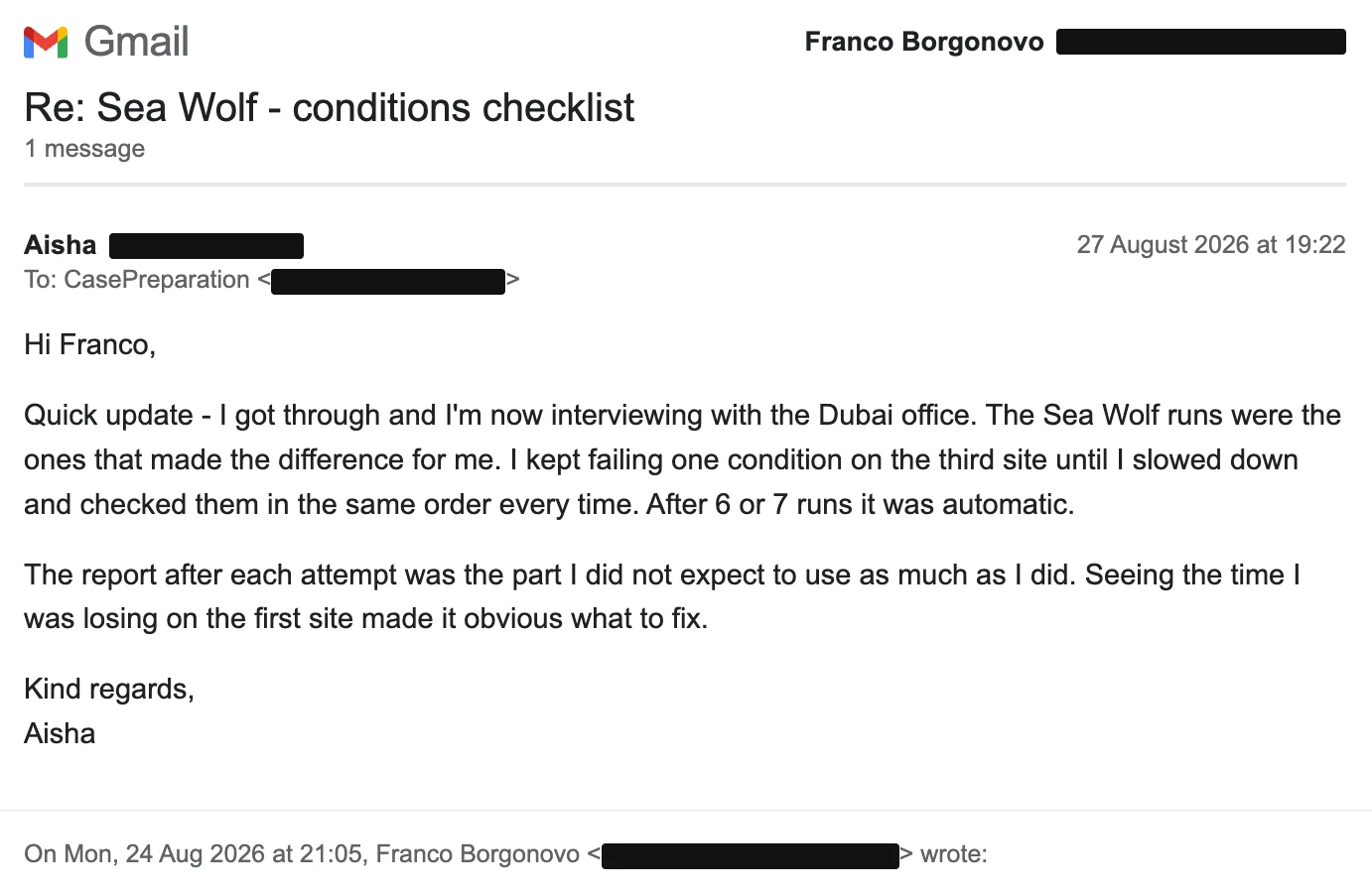
Aisha, McKinsey Solve candidate: a checklist of conditions, and the report showed where she was losing time on the third site.
Sustainable Futures Lab: how your decisions read
The Lab reports organise feedback around five skills used by our simulator (prioritisation, decision-making under uncertainty, interpreting messy information, balancing trade-offs, and team and stakeholder effectiveness), with written comments on your decisions. The 30-minute report also follows each researcher day by day, so you can see, for example, where you felt confident about a person but read the situation wrong. These are the simulator's own measures, not McKinsey's, which publishes no scoring categories. Use them to choose which kind of situation to think through before the next run.
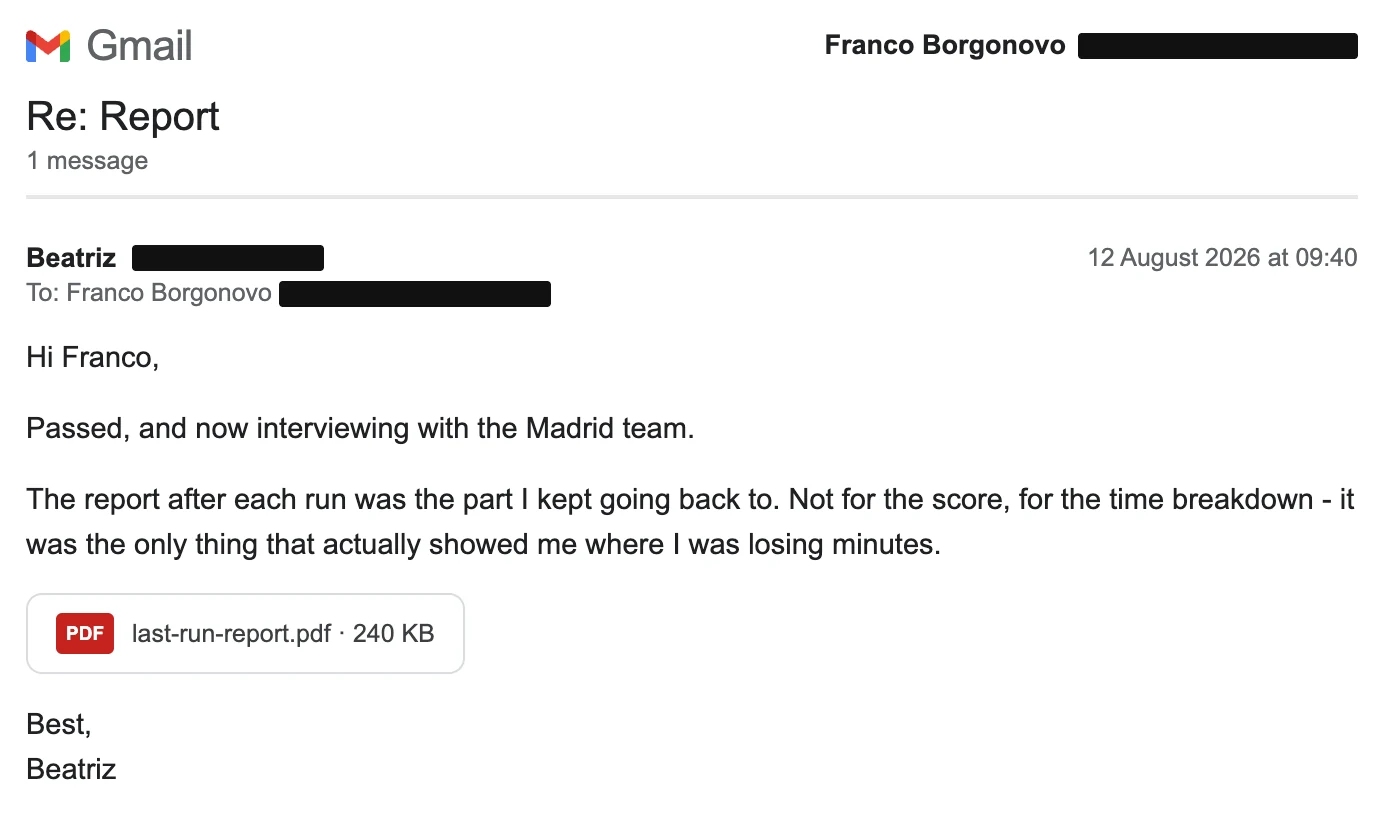
Beatriz, McKinsey Solve candidate: the report after every run, and the detail on timing, showed her what to change.
McKinsey Solve · full access
A report after every run, so each fix has a reason
The free trial shows you where you struggle. Full access adds the scenarios and the detailed feedback you need to run the loop several times.
- 15 Redrock Study scenarios and unlimited generated Sea Wolf runs
- 10 Sustainable Futures Lab scenarios, in both the 20 and the 30-minute format
- A detailed report and PDF after every run; new scenarios released during your access are included
- US$149, one payment, 12 months of access
Money-back guarantee if you do not pass McKinsey Solve, subject to conditions, including at least five full runs of each game before your test. CasePreparation is independent and not affiliated with McKinsey & Company.
Three plans by time available
Candidates commonly report about a week between invitation and deadline, but check your own date and choose a slot well before the last evening, in case of technical problems. Pick the plan below that matches your time, and keep the same loop inside it: run, review, one fix, run again.
A full run of all three games takes about 85 or 95 minutes plus tutorials, and a single game 20 to 35 minutes. A useful session is therefore about an hour: one game under time, the ten-minute review, and a short practice of the fix.
A few days (two to four)
With little time, you cannot fix everything, so you fix what costs most. Focus on your weakest game and on pacing in all three, so you can finish without rushing the final decisions.
| When | Focus | What to do |
|---|---|---|
| Day 1 | Rules and diagnosis | Read the official rules; one timed run of each game; note where time ran out |
| Day 2 | Weakest game | Practise its main fix, then one timed run and compare |
| Day 3 | Pacing everywhere | One timed run of each of the other two games with your time checks |
| Last day | Rehearsal and checks | All three in test order if time allows; technical check; rest |
If you have only two days, merge Days 2 and 3: one focused run on the weakest game in the morning, the other two games with time checks later.
One to two weeks
This schedule makes room for two or three full loops per game. Alternate full runs with targeted practice, so that each run tests a fix.
| When | Focus | What to do |
|---|---|---|
| Days 1 to 2 | Diagnosis | Rules; one timed run of each game; ten-minute review of each |
| Days 3 to 5 | Weakest game | Two loops: fix, timed run, compare |
| Days 6 to 8 | The other two games | One or two loops each, using the time checks you have set |
| Days 9 to 11 | Second weakest point | A fresh scenario of each game, to check the fixes hold on new data |
| Second to last day | Full rehearsal | All three games in test order, under time, then a short review |
| Last day | Rest and check | Technical check, paper and pen ready, no new runs late in the day |
For a one-week window, compress Days 3 to 11 into four days: one loop on the weakest game, one on each of the others, and one fresh scenario of each.
Three weeks or more
With more time, the risk changes: you may play too often without reviewing. Keep the loops, add variety, and start preparing for the interviews, which usually follow within a few weeks of a positive result.
| When | Focus | What to do |
|---|---|---|
| Week 1 | Diagnosis and first loops | First runs of each game, then one loop on each |
| Week 2 | Recurring mistakes and variety | New scenarios of each game; practise any mistake that comes back twice |
| Week 3 | Rehearsal | Two full rehearsals in test order a few days apart; rest before the test |
| Throughout | Interviews | Two or three hours a week on cases and on stories for the Personal Experience Interview |
If you do not have an invitation yet, the same plan works at a slower pace. One or two loops a week keep the format familiar while most of your time goes to case preparation.
There is no official number. In a one-to-two week plan most candidates can complete several reviewed runs of each game, and the first and last runs are what you compare. If you intend to rely on our money-back guarantee, its conditions include at least five full runs of each game before your test: in a 95-minute version that is about eight hours of play, which fits a one-to-two week plan more comfortably than a few days.
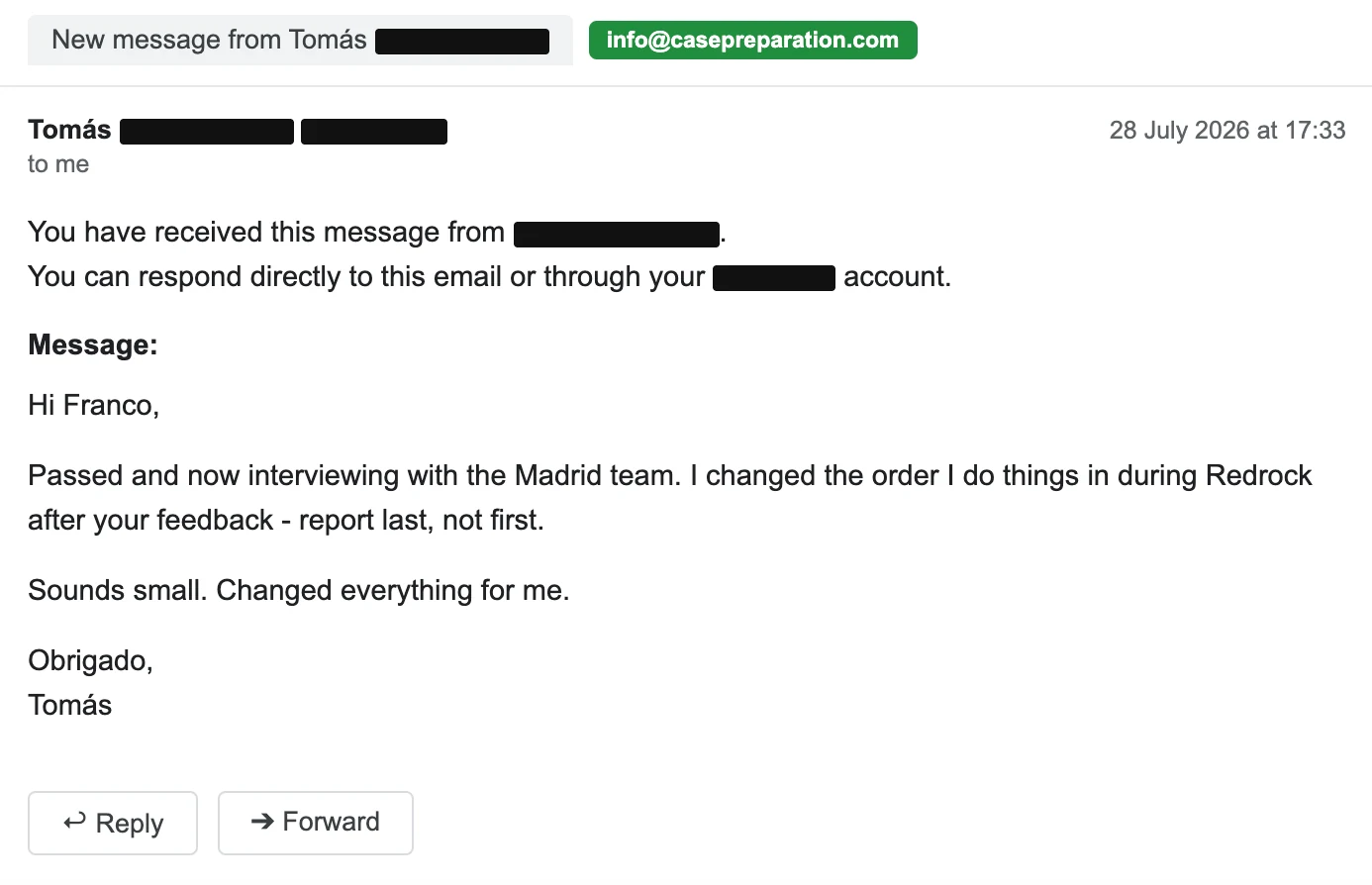
Tomás, McKinsey Solve candidate: after feedback on his practice, he changed the order in which he worked through Redrock.
The day before and the day of the test
The rules in McKinsey's FAQ are short, and breaking them can cost much more than a weak score. Plan your test day around them.
- Each task begins with an untimed tutorial that explains the objective and the controls.
- The assessment runs only on a PC or Mac; sound is not needed and a mouse is optional.
- Applications, websites, AI tools and pre-prepared notes are not allowed unless an accommodation has been approved in writing. You must complete it alone, and you may not record or screenshot it.
- Technical problems must be reported to support while they happen; McKinsey says it cannot make exceptions for a reset otherwise.
- You may be asked at random to explain your logic or to complete an additional task in person.
- Your result is considered together with the rest of your application.
The day before
- Run the technical check on the computer you will use, and decide the time slot. Choose a moment when you are usually alert, not the last hour before the deadline.
- Do not play a new full run late in the day. A short look at your review notes is more useful than another run.
- If you need an accommodation, for example extra time for a learning difficulty or a health condition, agree it with your recruiter in writing before you start.
On the day
Candidates widely report working on blank paper during the games, since the ban covers notes prepared in advance; if you are unsure about anything specific to your case, ask your recruiter. During the test, use each untimed tutorial calmly, keep the time checks you practised, and remember that each game is reported to have its own clock, so time saved in one does not carry over. An answer is usually better than a blank: if the clock is almost over, decide with what you have and move on.
Some guides suggest spreadsheet tools for Sea Wolf. The FAQ bans applications during the assessment and says violations may exclude you from consideration. A quick check by hand, with the conditions written down first, is enough.
After McKinsey Solve: the case interview and the PEI
McKinsey says that your result is considered together with the rest of your application, and candidates commonly report that a positive outcome leads to the first interviews within a few weeks. The interviews test things the games do not. In the case interview you structure a problem out loud, do maths while talking to an interviewer and turn analysis into a recommendation. In the Personal Experience Interview (PEI) you tell real stories from your past, in depth, and answer detailed follow-up questions.
The skills overlap only in part. Redrock helps with reading data and simple maths, and the Lab with judgement, but neither replaces practice with a person asking you questions. If your plan has two weeks or more, start now with a few hours a week: choose your PEI stories, and practise a handful of cases out loud. The complete guide to case interview preparation explains the case and the fit interview step by step, and the guide to the McKinsey PEI covers story choice and structure.
If you want practice with a former interviewer, Franco offers one-to-one interview coaching, with a written report after each session.
Frequently asked questions
How long does it take to prepare for McKinsey Solve?
There is no official answer, and McKinsey says no preparation is needed. Start by learning the interface, then review a timed run to decide how much practice you need. Use additional scenarios to check whether you can apply the improvements on new data, rather than relying on familiarity with one scenario.
Should I practise every game or focus on one?
Practise all three at least once under time, then give most of your time to the weakest. The game you avoid is usually the one where a few hours make the biggest difference.
Can I prepare in one day?
You can still do something useful: read the rules, play one timed run of each game, and set one time check per game. Avoid exhausting yourself with many runs the night before.
Is the free trial enough?
It is enough to learn the interface and see where you struggle, and you can replay each free scenario. For several loops on new data and a report that explains why you lost points, you need more scenarios, which is what full access adds.
Does a good practice score mean I will pass?
No. Practice scenarios reproduce the games as candidates report them, but McKinsey's scoring is not published. Use practice results to find and fix weak points, not as a forecast.
What if I do not know whether I will get the 20 or the 30-minute Lab?
Use the length in your invitation as the main clue, and if you are unsure, practise both formats. Redrock and Sea Wolf are reported to be the same in both versions.
Where to start
Start today with one timed run of each game, before reading more. Twenty to thirty minutes of play will tell you which game to work on first, and the complete McKinsey Solve guide and the deep dives on Redrock Study, The Sea Wolf and Sustainable Futures Lab are there when you know what you need.
McKinsey Solve · free trial
Make your first run a diagnosis
One complete timed scenario of each game, replayable as often as you like. No card needed, and nothing to cancel.
CasePreparation is independent and not affiliated with McKinsey & Company.

About Franco
Franco Borgonovo
Former BCG Principal · 10-year tenure · Official BCG coachFranco spent ten years at BCG, from intern to Principal, interviewing and selecting candidates as a global lead recruiter. He is still an official BCG coach for new hires, and today works one to one with candidates on applications, McKinsey Solve and interviews.
More about Franco →- McKinsey Solve FAQ (September 2026) · official: length stated in the invitation, untimed tutorials, PC or Mac, prohibited tools, technical support, accommodations
- McKinsey careers: interviewing · official: where McKinsey Solve sits in the process; McKinsey says no preparation is needed (seen 2 November 2026)