- The Lab centres on judgement with incomplete information, on priorities and on how you handle people and resources. It relies far less on calculation than Redrock Study.
- Candidates report two formats: 20 minutes (one ranking and twelve situational questions) and 30 minutes (leading a research team over three simulated days). The length in your invitation is the most useful clue, but it is not a guarantee.
- In the 30-minute format information is scarce, so spend your few requests on what could change a decision.
- Consistency means having a reason for every move and keeping your commitments. It does not mean refusing to change when new facts arrive.
- You can practise the 20-minute format free; the 30-minute format and the detailed reports come with full access.
What the Lab is designed to observe
The Sustainable Futures Lab is the third game of McKinsey Solve, alongside Redrock Study and The Sea Wolf. Redrock asks you to find data and calculate (worked examples here), and Sea Wolf asks you to satisfy several conditions at once (rules and examples here). The Lab instead puts you in charge of a sustainability project and asks you to decide what to find out, what to prioritise and how to work with the people involved.
It centres on judgement more than calculation. Simple reasoning with numbers can help, but what matters most is which information you look for, what you conclude from it, and whether your decisions fit together. Prepare by practising how you make and explain decisions, as well as how quickly you reach them.
McKinsey does not publish how the Lab is scored. It is widely reported that McKinsey Solve records how you work as well as your answers, so prepare a sound way of deciding rather than memorising "correct" answers.
McKinsey's official FAQ (August 2025) says that the length of the assessment is given in your invitation email, that each game opens with an untimed tutorial, and that applications, websites, AI tools and prepared notes are not allowed. Everything else in this article about how the Lab works comes from candidate reports, not from McKinsey. CasePreparation is independent and not affiliated with McKinsey & Company.
The two formats candidates report
In 2026 candidates have described two versions of the Lab. Redrock Study (about 35 minutes) and The Sea Wolf (about 30 minutes) appear to be the same in both, so the difference in total length comes from the Lab, as our complete McKinsey Solve guide explains.
| 20-minute format | 30-minute format | |
|---|---|---|
| Total in the invitation (reported) | About 85 minutes | About 95 minutes |
| Your role | Working through a project brief | Leading a small research team for three simulated days |
| What you do | Rank priorities once, then answer twelve situational questions | Rank four briefing questions, then each day Explore, Assign, Support and Reflect |
| Main challenge | Choosing the best response in each situation, consistently | Using scarce information well and managing people over time |
According to candidate reports, the length in your invitation is the most useful clue to which format you will get. It is not a guarantee, because the 30-minute version has only been reported since late August 2026 and both versions seem to be in circulation. If your assessment is close and you are unsure, practise both.
The 20-minute format: one ranking and twelve situations
In the 20-minute format, candidates report that you read a project brief, rank a set of priorities, and then answer twelve situational questions. Each question describes a moment in the project, such as a new data point, two sources that disagree or a colleague who raises a concern, and asks you to choose one response from several.
The options are usually all plausible. Weaker responses tend to go to an extreme: acting at once on partial evidence, waiting for perfect information when the decision cannot wait, or ignoring the people involved. Stronger responses deal with the problem at the right scale and keep the project moving.
Three habits help in this format:
- Treat the opening ranking as a commitment. The priorities you put first set expectations for the questions that follow. If a later answer goes against them, it should be because the question gives you a new fact.
- Find the deciding fact before you compare options. Most situations contain one element that settles the question, such as a fixed deadline, an approval that is still missing or a sample that is too small. Spot it first, then read the options.
- Match the response to the size of the problem. A small anomaly rarely justifies stopping the project, and a broken assumption at the heart of the recommendation rarely justifies carrying on unchanged.
Thirteen tasks in about 20 minutes leave roughly a minute and a half per task. Use that as a pacing reference, allowing more time for the opening brief and the longer questions.
The 30-minute format: three days leading a research team
In the 30-minute format, candidates report that you lead a small research team through three simulated days. After an untimed tutorial, a single 30-minute clock covers everything else. You start with an onboarding task in which you put four briefing questions in order of priority, and then each day follows the same four steps.
Explore
You put a few questions to members of the team. Requests are scarce, about two or three a day according to reports, so each one should target information that could change a decision.
Assign
You place researchers on workstations, with at most two people per station. Each time you move someone, you pick the reason for the move from a fixed list.
Support
Team members bring you requests and dilemmas at the same time. You choose which one to handle first, then pick one of several responses, with no immediate feedback.
Reflect
At the end of the day you say how each team member is feeling. "I don't know" is one of the available answers.
Candidates also report that each day has a different goal: first the researchers and their needs, then the workstations and the work they require, then the balance between the two. The same placement can therefore be sensible on day one and weak on day two.
Two practical points come up in candidate reports. On-screen notes do not carry over to the next day, so keep track of facts and commitments using the materials permitted by your assessment instructions. With onboarding included, plan for slightly less than ten minutes per simulated day.
Using scarce information well
With two or three questions a day, the challenge is to know what matters. Before each request, name the decision you are about to make (who goes where, which request to handle first) and the single fact that would most change it. A question whose answer would not change anything you do is usually a wasted request.
Consistency: when to hold a decision and when to change it
Consistency is one of the most misunderstood ideas about the Lab. It does not mean keeping every earlier decision; it means that your decisions follow from what you know and from what you have told people.
Hold steady
When nothing relevant has changed. Moving people without a reason, or reversing yesterday's priority on a whim, disrupts the team and makes your plan hard to follow.
Change
When new information makes the earlier choice worse. The right move is then to change and to be clear about why, so the reason you give matches the new fact.
Keep your word
If you told a researcher they would lead a task tomorrow, keep that promise. If the facts genuinely make it impossible, deal with it openly rather than letting it slip.
Before any change, check that you could explain it in one sentence starting with the new fact. "The replacement parts are three days late, so..." is a good reason; "I wanted to try a different set-up" is not.
A worked decision, step by step
The example below is fictional, not taken from the real test or from our scenarios, and deliberately simple so the reasoning is easy to follow.
The situation
You lead a three-person team on a two-week air-quality pilot in a city district. Today there are two workstations. At Sensor installation, 20 street sensors must be mounted before measurement starts in two days. At Resident interviews, the team is collecting residents' views on the pilot.
- Ana, a field technician experienced with installation, is on Sensor installation.
- Ben, a data analyst, is on Resident interviews. Yesterday he mentioned that he would like to learn the installation side.
- Chloe, a community officer, is also on Resident interviews.
You can ask two questions today.
Step 1: decide what you need to know
The decision in front of you is whether today's placement is right. Two facts could change it: how far behind installation is, and whether the interviews really need two people. A question about the design of the final dashboard might be interesting, but its answer would not change anything you do today.
So you ask Ana how many sensors are mounted and how many she can mount alone in a day, and you ask Chloe how many interviews remain. Ana says 8 of the 20 are up and that she manages about 4 a day alone. Chloe says 10 interviews remain and that she can finish them alone by the end of the week, which is within the deadline. For this example, assume Ben can install about 3 sensors a day while learning alongside Ana.
Sensors left: 20 − 8 = 12
Ana alone: 4 a day × 2 days = 8, so 4 short
Ana and Ben together: (4 + 3) a day × 2 days = 14, enough for 12
Step 2: make the choice
Chloe can cover the interviews alone, while Ana cannot finish installation alone in time. Moving Ben to Sensor installation closes the gap, and it also matches the interest he mentioned. You move Ben and record the workload at installation as the reason, because that is the fact driving the decision. Ana and Chloe stay where they are, since nothing suggests moving them.
You also tell Ben that he will return to the data work once the sensors are up. He says he is pleased with the plan, and you write on paper: "Ben back to data when installation is done."
Step 3: a new fact arrives
The next morning, 15 sensors are up. Then the supplier reports that the last 5 are faulty and that replacements will arrive in three days, and the project sponsor moves the start of measurement accordingly. There is nothing left to install today, and when the replacements arrive Ana can mount them alone in a little over a day.
The sensible revision is to move Ben back to the data work, recording the supplier delay as the reason. This is a change, but a consistent one: the reason for yesterday's move has gone, and the new placement keeps your promise to Ben. Keeping him at installation only to look consistent would waste his day.
Step 4: reflect on the team
At the end of the day you are asked how each person feels. Ben told you he was pleased with the plan, so you have some evidence for a positive answer. You asked Chloe only about her workload and never about how she felt, so the honest answer for her is "I don't know".
What the example shows
Each request was chosen because its answer could change the placement, and each move had a reason that matched a fact you had collected. The decision changed when the facts changed, the promise to Ben was kept, and in Reflect you answered only from evidence, using "I don't know" where you had none.
How to practise the Lab
Practice works best when you review your reasoning, not just your result, so a short cycle is more useful than many runs in a row.
- Play one timed run without stopping. Note the moments where you hesitated or ran short of time.
- Review each choice you were unsure about. For each one, write down the fact that should have decided it and whether you had collected that fact.
- Practise the format your invitation suggests. If you expect the 30-minute format, or you are unsure, get used to Explore, Assign, Support and Reflect before the test, because the mechanics take a run or two to feel natural.
- Replay with one thing to improve. Choose a different scenario and focus on the habit you identified, such as using requests better or keeping track of commitments.
You can start with the free McKinsey Solve trial, which includes one 20-minute Lab scenario, Saltmarsh Recovery, that you can replay as often as you like. It shows how the questions feel under time, but does not include a detailed report.
With full access, each run ends with a detailed report. The 30-minute report opens with your skill scores, then shows suggested priorities for the briefing and, for each day, how every researcher started and ended the day, with points on what you did well and what to improve. The 20-minute report covers five skills (prioritisation, decision-making under uncertainty, interpreting messy information, balancing trade-offs, and team and stakeholder effectiveness) and comments on each of your choices, with the full situation and, where useful, a stronger response.
A run tells you how the test felt. The report shows which decisions held up and why, and explains the stronger option in words, so you can carry the reasoning into a new scenario instead of memorising answers. The skills in the report are how our simulator organises feedback; McKinsey does not publish its own scoring categories for the Lab.
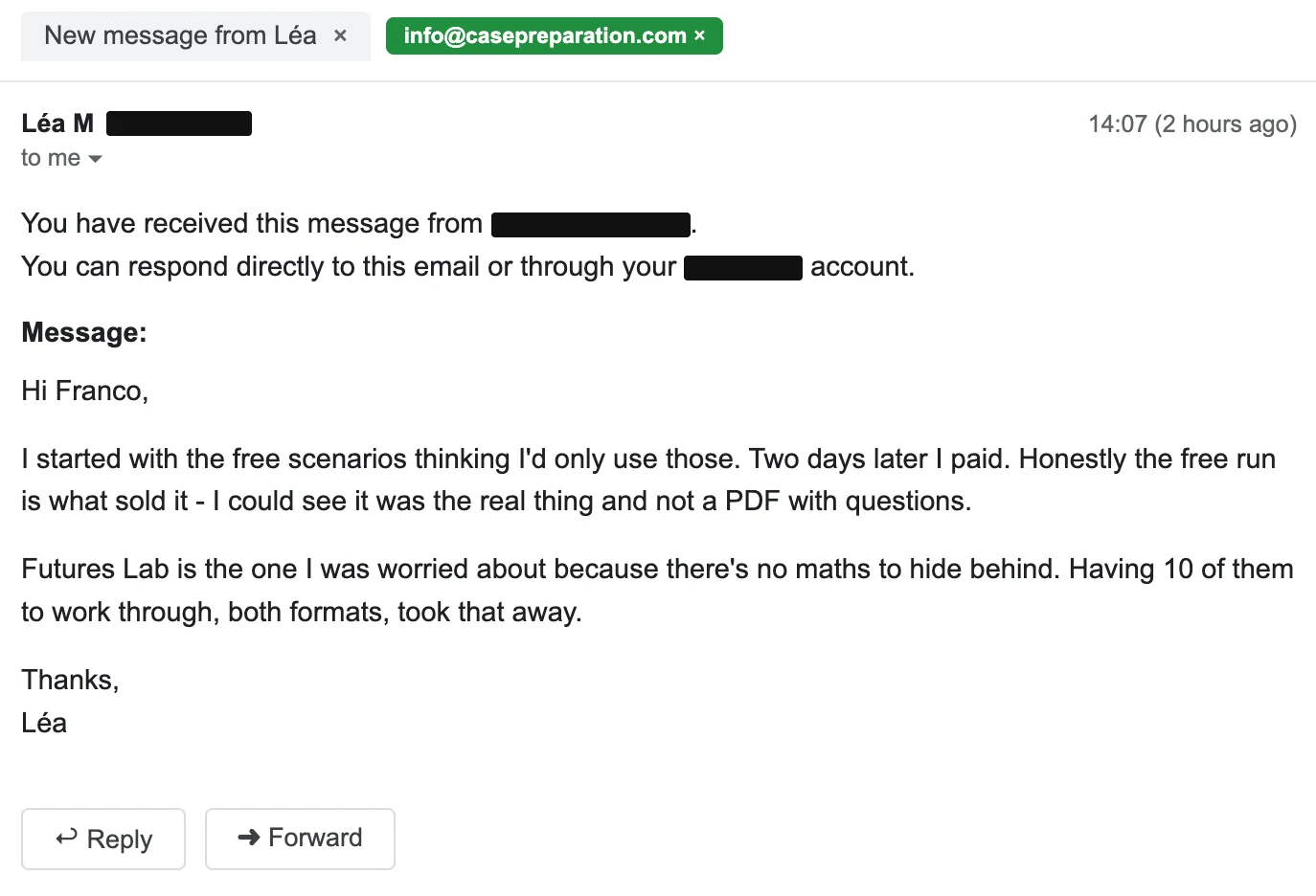
Léa, McKinsey Solve candidate: the free run first, then both Lab formats to work through.
McKinsey Solve full access
Practise both Lab formats, with a report after every run
Full access includes 10 Sustainable Futures Lab scenarios across both formats, plus all the Redrock Study and Sea Wolf practice.
- The 30-minute format with Explore, Assign, Support and Reflect over three days
- Detailed reports in the browser and as a PDF
- 12 months of access, with new scenarios included
Money-back guarantee if you do not pass McKinsey Solve, subject to conditions.
Mistakes to avoid
- Spending information requests on questions that are interesting but would not change a decision.
- Moving people without a reason, or choosing a reason that does not match the facts you have.
- Refusing to change a decision after new information arrives, just to look consistent.
- Saying how someone feels when you never asked them, instead of answering "I don't know".
- Picking the most extreme response because it sounds decisive.
Where to start
If you have not seen the Lab yet, play the free 20-minute scenario once under time and note where you hesitated. Then decide, from your invitation and your timeline, whether you also need the 30-minute format. The Lab is one game of three, so plan across the whole of McKinsey Solve with the complete guide.
Free trial
See how the Lab feels before assessment day
Play one complete, timed scenario of each game, including the 20-minute Lab, and replay it as often as you like.
No credit card needed. CasePreparation is independent and not affiliated with McKinsey & Company.

About Franco
Franco Borgonovo
Former BCG Principal · 10-year tenure · Official BCG coachFranco spent ten years at BCG, from intern to Principal, interviewing and selecting candidates as a global lead recruiter. He is still an official BCG coach for new hires, and today works one to one with candidates on applications, McKinsey Solve and interviews.
More about Franco →