- A final round tests the same skills as the first: structure, maths, charts, judgement, synthesis and fit. The interviewers are more senior, fit usually takes more time, and the case can be shorter, more open or more qualitative.
- Most final-round interviews still look like first-round interviews. Prepare for the normal case first, and practise handling interruptions and pushback rather than hunting for unusual cases.
- The decision is reported to be made in a debrief where interviewers compare notes. An interviewer who argues for you helps; a serious concern raised by one interviewer is hard to outweigh.
- Start from your first-round feedback. Weak points noticed in the first round are often tested again in the final.
- In the last days, a few realistic mocks with serious feedback are worth more than many new cases. Rehearse your stories and prepare specific questions for senior interviewers.
Reaching the final round means you have already shown the core skills at least once. The final round asks a different question: are you consistently good enough to hire, in front of people who decide? This guide explains what a final round is at the three largest strategy firms, how interviewers reach a decision, and how to use the days you have left. If you want a refresher on how a case interview works from start to finish, the complete case interview guide covers it with a worked mini-case.
What changes in the final round
Most large consulting firms run two rounds of interviews after the CV screen and any online test. Candidates commonly report two or three interviews per round, each combining a fit or experience part with a case. The final round is the last of these rounds, and it usually leads directly to an offer or a rejection.
The table summarises what candidates and former interviewers commonly report. It is a general pattern, not a rule: firms do not publish how rounds differ, and interviewers have a lot of freedom.
| Aspect | First round | Final round |
|---|---|---|
| Interviewers | Consultants, managers, sometimes principals | Partners, principals, managing directors |
| Fit part | Often 10 to 15 minutes | Often longer; it can take half of the interview |
| Case | Standard business case with structure, maths and charts | Often the same; sometimes shorter, more open or purely qualitative |
| What is tested | Whether you have the core skills | Whether you show them consistently, with judgement and under pressure |
Ask how many interviews you will have, who the interviewers are (level and practice area, if they can share it), how long each interview lasts, whether it is online or in the office, and whether there is a written case or presentation. Recruiters answer these questions routinely, and the answer for your office beats any general description, including this one.
McKinsey, BCG and Bain: what is official and what is reported
Each firm publishes the elements of its process but not how many rounds there are or what makes the last one different. The table separates the two.
| Firm | What the firm publishes | What candidates report about the final round |
|---|---|---|
| McKinsey | An assessment (McKinsey Solve for most consulting roles), then interviews that combine a Personal Experience Interview (PEI) and a Problem Solving Interview (case) | Partners interview; each interview still has a PEI story and a case, often led by the interviewer |
| BCG | Four steps: application, an interview on your experience, skills and motivation, a case interview for client-facing roles, and a team interview | Partners or principals interview; more open discussion and more time on motivation and "why BCG" |
| Bain | Interviews adapted to the role, with the same questions for candidates in the same role; for consulting, usually a digital assessment and one or more cases; some roles include a behavioural interview | Partners interview; cases can be more open, and behavioural questions may come in a separate interview |
In all three firms, what you are evaluated on does not change between rounds. What changes is who is in front of you and how much room they take to test you.
Who interviews you and what they look for
Final-round interviewers are senior: partners, principals or managing directors, sometimes from the office you would join. They may have access to feedback from your first round. A senior interviewer usually cares less about whether you completed every calculation and more about whether they would put you in front of a client: whether your thinking holds when challenged, whether you have business sense, and whether you would be good to work with on a difficult project.
That is why interviewers at this level often step outside the script. They may interrupt your structure, question an assumption, ask for your answer before you have the data, or spend most of the time on your experience and motivation.
The formats you may meet
The formats below are reported by candidates in final rounds at large firms. The first is by far the most common.
A standard interview
Fit questions, a full business case with numbers and a chart, then your questions. Most final-round interviews look like this.
A long fit part
Twenty or thirty minutes on your experiences and motivation, with deep follow-up questions, and a shorter case.
A qualitative case
Few or no numbers. You structure the problem, propose analyses, discuss risks and defend a recommendation.
A real problem
The interviewer describes a problem from their own work and asks how you would approach it. There is no prepared solution.
Occasionally an interviewer deliberately plays a tough role to see how you handle pressure: frequent interruptions, blunt challenges, little encouragement. A difficult interview of this kind is a test of composure, not necessarily a sign that it is going badly. Stay calm, keep answering the question, and do not try to read the outcome from the interviewer's manner.
Candidates often expect the final round to be completely different and spend their last days on unusual cases found online. In practice, most report a normal case and a longer fit part. Unusual cases do happen, especially with very senior interviewers, but preparing for the standard interview first is the better use of limited time.
How the final decision is reached
Firms do not publish their evaluation forms, scales or decision rules, and they differ between firms. What follows is the general practice reported by former interviewers at large consulting firms.
What each interviewer writes
After each interview, the interviewer rates you on the firm's dimensions, writes a short justification with the evidence behind it and gives an overall recommendation. The evidence is concrete: the structure you proposed, whether a calculation was right the first time, how you reacted when challenged, what you said in your recommendation, which details of your story held up under questions.
What happens in the debrief
The interviewers then discuss each candidate together, usually with the first-round evaluations available. Two things matter in that discussion. The first is whether someone is ready to argue for you because they saw a clear strength. The second is whether anyone has a serious concern. A dimension rated well below the bar, or the same weakness seen in both rounds, is hard to offset with good scores elsewhere.
Consistency matters more than one brilliant interview. A candidate who is solid in every interview is usually discussed differently from one who alternates excellent and weak performances, because the firm is trying to predict how you will work every day.
What this means for your preparation
Reaching the final round means you have passed an important screen, but the final round is not a formality. The practical consequences are simple: avoid a serious red flag in any single interview, make your strengths visible so that someone can argue for you, and do not repeat a weakness that was noted in the first round.
- Repeating an error that was pointed out in the first round.
- Losing your structure when the interviewer interrupts or changes direction.
- Defending a weak point stubbornly instead of reconsidering, or dropping a good point at the first challenge.
- A recommendation that summarises the case instead of answering the question.
- Fit stories that become vague under follow-up questions, or a "why this firm" that could apply to any firm.
- Having no questions for a partner, or questions you could have answered with a web search.
Start from your first-round feedback
The most useful information you have is how the first round went. Interviewers in the final round often probe the areas where the first-round notes showed doubts, or the areas that were not tested for lack of time. Your plan should start there, not from a new list of case types.
How to get feedback
Ask your recruiter, not the interviewers. When the recruiter calls to invite you to the final round, ask whether there is any feedback from the first round and anything they suggest you focus on. Some recruiters share a few points, others share nothing; either is normal. Contacting interviewers directly for feedback is not appropriate, and they are usually not allowed to give it outside the recruiting team.
If you have no feedback, assess yourself
Write down your own assessment the same day as each interview, while you still remember the details. Be specific: where you needed a prompt, where your calculations needed checking and how well you handled follow-ups, without recording or reproducing confidential interview questions. Then use the questions below.
| Area | Ask yourself | Needs work if |
|---|---|---|
| Structure | Was my structure built for this problem, and did I use it? | It was generic, or I abandoned it after five minutes |
| Maths and charts | Were my numbers right the first time, and did I say what they meant? | I needed help, or stopped at the number |
| Judgement | Were my ideas specific to the client and prioritised? | I listed ideas without saying which mattered |
| Case leadership | Did I propose the next step myself? | I waited to be told what to look at |
| Synthesis | Did my recommendation start with the answer? | I retold the case in order |
| Fit | Did my stories show my own decisions, and survive "why?" | I said "we" and stayed at the surface |
Turn the feedback into two priorities
Pick the two items that would most worry an interviewer and work on them every day. Two is enough: trying to fix everything in a week usually fixes nothing.
The feedback
A candidate hears from the recruiter: "Good structure and very pleasant in the fit part. One interviewer felt you needed help to interpret the second chart and to move the case forward."
The two priorities
- Charts: read title, axes and units first, state the main movement in one sentence, then say what it means for the question. Drill one chart a day, out loud, in two minutes.
- Case leadership: after every analysis, say what you want to look at next and why. In every practice case, ask your partner to stay silent until you propose the next step.
What not to do
Spend the week on new case types. The first-round interviewers already saw a good structure; the final-round interviewers will look at charts and leadership.
If you cannot tell which errors would actually weigh in a debrief, this is where an outside view helps most. A final-round mock with Franco starts from your first-round experience and ends with a written report that names the two or three things to fix first.
A plan for the last 7 to 10 days
The time between rounds is often one to three weeks, and sometimes only a few days. The plan below assumes about ten days; compress it if you have less, keeping the order.
| Days left | Focus | What to do |
|---|---|---|
| 10 to 8 | Diagnosis | Get or write your first-round feedback; choose two priorities; ask the recruiter about the format |
| 8 to 4 | Targeted practice | Drill your two priorities daily; one full case a day or every other day with the best partner you can find; one realistic mock with an experienced interviewer |
| 8 to 2 | Fit and questions | Rehearse your stories aloud with follow-up questions; refine "why consulting", "why this firm", "why this office"; prepare your questions |
| 3 to 2 | Pressure test | A second realistic mock with interruptions and pushback; review only your recurring errors |
| 1 | Rest | No new cases; reread your notes, prepare logistics, sleep |
Fewer mocks, more feedback
At this stage, doing many new cases adds little. You already know how a case works; what you need is to stop the errors that could cost you the offer. Two or three realistic mocks, each followed by honest and specific feedback and by targeted practice, do more than ten quick cases with a partner who tells you it went well.
A realistic mock has three features: an interviewer who does not help you more than a real one would, interruptions and challenges at the level of a partner, and feedback that says what would weigh in the decision. Peer practice remains useful for rhythm and confidence, but a partner who is also a candidate rarely sees why a senior interviewer would hesitate.
Keep the pace sustainable. One case a day, or one every other day, is usually enough if your performance is already consistent. Arriving tired after a week of four cases a day is a common and avoidable mistake.
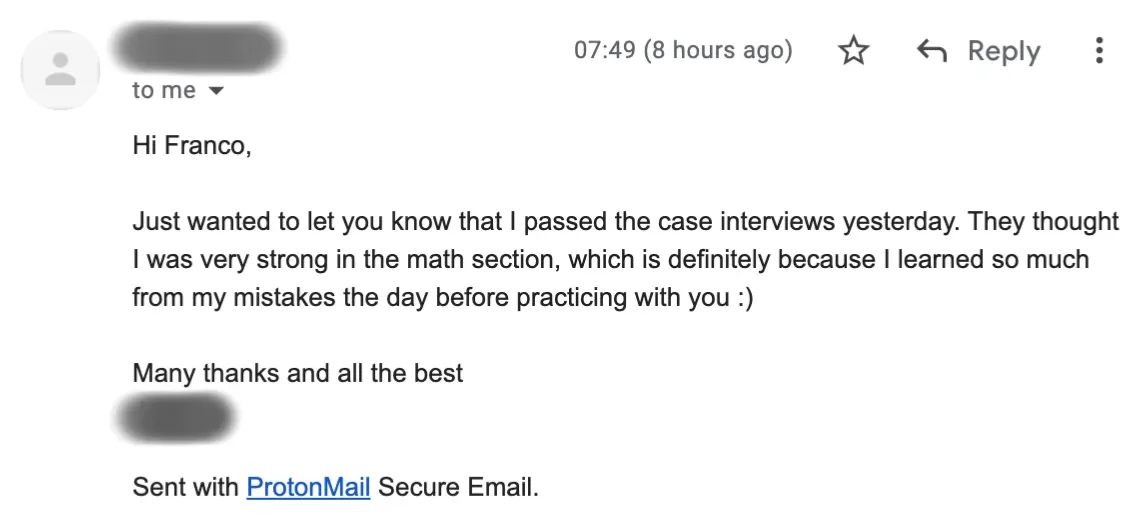
A Bain candidate, after a session the day before the case interviews. One candidate's experience; results depend on each candidate and process.
If your interview is in two or three days
Do one realistic mock if you can, drill only your two priorities, rehearse your three strongest stories aloud, and prepare five good questions. Then stop. Last-minute cramming of new frameworks tends to make answers more mechanical, which is the opposite of what senior interviewers want.
Partner-style cases and pushback
Senior interviewers often test whether your thinking holds when the conversation leaves the script. The common moves are predictable even if the cases are not: they interrupt the structure, challenge an assumption, ask for your answer before the analysis, push back on the recommendation, or ask about a problem from their own work. The examples below are fictional and show a weaker and a stronger response to each move.
The situation
Your client is a regional chain of 40 bakeries whose profit has fallen. Your analysis shows that 8 shops lose £0.6m in total every year, and you recommend closing them. The partner replies: "I don't buy it. Those are the founder's first shops. She will never close them. What now?"
"You're right, closing them might be too drastic. Maybe we could look at other options, like marketing or new products."
"That's an important constraint, so let me separate the two questions. On the numbers, the 8 shops lose about £0.6m a year, so doing nothing has a real cost. Given the founder's attachment, I'd propose a middle path: keep the two original shops as flagships, and for the other six test a turnaround for six months with clear targets on rent and staffing. If they don't reach break-even, we bring the closure back to the founder with that evidence."
The weaker answer drops the analysis at the first challenge. The stronger one accepts the new information, keeps the facts that still hold and adapts the recommendation into something the client could actually decide. Being challenged is not a sign you were wrong; the interviewer wants to see whether you can reason with a new constraint.
The situation
A partner gives you the prompt: a mid-sized hotel group wants to know whether to launch a budget brand. As you start to lay out your structure, they interrupt: "Skip that. If you had to answer now, would you do it?"
"It's hard to say without the data. I'd need to look at the market, the competitors and the costs first."
"My initial answer is yes, but only if the budget brand doesn't take guests from their existing hotels. I would test whether demand for budget hotels is growing and whether the group can use its booking systems and procurement scale. What would change my mind is cannibalisation, so that's the first thing I'd check, followed by whether they can find sites at the right cost."
The interviewer is testing judgement, not knowledge. A hypothesis with a reason and a clear condition that would change it shows business sense and gives the rest of the case a direction. Refusing to answer looks like dependence on a framework.
The situation
The interviewer says: "I'm working with a hospital group that wants to cut waiting times for scans. How would you approach it?" There are no exhibits and no numbers.
A strong approach in four moves
- Clarify the objective: which scans, which waiting time (referral to scan, or scan to result) and what target.
- Structure the problem out loud: demand (how many requests, how many are necessary), capacity (machines, opening hours, staff, no-shows) and process (scheduling, reporting time).
- Say where you would start and why: for example, machine utilisation by hour, because extra hours on existing machines are faster than buying new ones.
- Discuss risks and stakeholders: staff availability, quality of reports, how doctors would react to stricter referral rules.
What the interviewer is looking for
A clear way to break down an unfamiliar problem, a sensible first step and an awareness of how the client organisation would react. Asking good questions here is part of the answer, not a delay.
Ask your practice partner to interrupt you at least three times per case: once during the structure, once by challenging an assumption and once on the recommendation. After the case, review only how you reacted. The aim is to stay calm, acknowledge the point, keep what still holds and move forward.
Fit in the final round and the questions you ask
Prepare fit as carefully as the case: senior interviewers may probe your motivation and experiences in depth. They want to know who you are, why you want this job, and whether they would trust you with a client and a team. At McKinsey, the Personal Experience Interview continues in the final round, with one story explored in depth per interview; at BCG and Bain, motivation and experience questions are often broader but can go just as deep.
Prepare stories that survive senior follow-up
Prepare eight to ten real stories from the last few years, with a backup for each theme, so that you never repeat a story within the round. For each, be ready to explain what you personally decided, why you chose that option over the alternatives, what was difficult about the people involved, and what you would do differently. Senior interviewers often ask fewer questions but go further into each answer. For the McKinsey format in detail, see how to choose and structure PEI stories.
"If I asked your former manager why we should hire you, she'd say I'm hard-working, a team player and very motivated."
"She would probably say I get people to agree on a decision when they start far apart. On a pricing project last year, sales and finance had blocked a decision for two months. I built one shared model with both teams, agreed the assumptions first and then the price, and we launched a month later. I think that's what makes a consultant useful to a client."
Questions framed in unusual ways ("what would your manager say", "why you rather than the other candidates today") are usually asking for your main strength. The stronger answer chooses one strength, proves it with a short real example and links it to the job. If the interviewer pushes back, defend it calmly with more detail rather than switching to another strength.
Questions to ask a senior interviewer
Most interviews end with your questions. With a partner, this is part of the conversation, not a formality. Good questions show that you have thought about the job and are curious about the person in front of you.
| Weaker question | Stronger question |
|---|---|
| "What is the culture like?" | "What did you look for when you staffed your last team, and what made someone stand out?" |
| "How many offices does the firm have?" | "How do projects in this office usually split between local clients and international teams?" |
| "What does a typical day look like?" | "What do new consultants usually find hardest in their first six months, and what helps?" |
| "Do you like working here?" | "What made you stay at the firm when you could have left for industry?" |
Prepare five or six questions and choose two or three in the moment, depending on the interviewer. Avoid questions about salary or holidays in an interview; those belong in the conversation with the recruiter.
On the day
A final round is often several interviews on the same day, in the office or online. A few habits help you stay consistent across all of them.
- Arrive early, or test your connection, camera and quiet room the day before if the interviews are online.
- Bring paper and pens; in most case interviews calculators and prepared notes are not allowed.
- Between interviews, do not replay the previous one. Each interviewer forms their own view, and a case that felt difficult may have gone better than you think.
- Start each interview fresh, with the same energy as the first. Consistency across interviews matters in the debrief.
- After the last interview, write down what you were asked and how it went. It helps if there is another step, and it helps your next process if there is not.
How coaching helps before a final round
Many candidates reach and pass a final round with peer practice alone. Coaching with an experienced interviewer helps most when you are not sure which of your errors would weigh in a debrief, or when you want to rehearse under conditions close to the real interview.
A final-round session with Franco is a realistic interview at the level of a senior interviewer, including interruptions and pushback, followed by a debrief and a written report with your scores by dimension and the priorities to work on before the interview. When you know your interviewers' background, the case can be chosen accordingly. A single session is designed for exactly this situation: preparing for a specific interview. If you are weighing whether coaching is worth it at all, this guide to case interview coaching explains when it helps and when it does not.
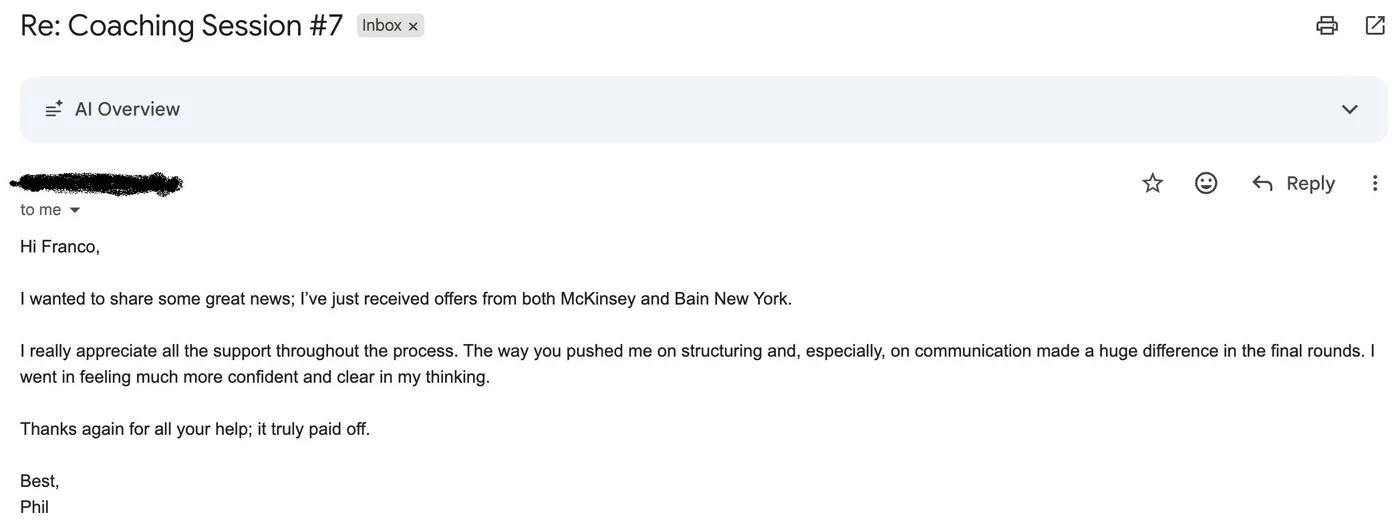
P., after 7+ sessions, with McKinsey and Bain New York offers. One candidate's experience; results depend on each candidate and process.
Final-round mock with Franco
Rehearse the final round with a former BCG Principal
Franco Borgonovo spent ten years at BCG, from intern to Principal, and has conducted more than 1,500 interviews, over 800 of them for MBB firms. Every session is with him, and ends with a written report.
- One session (US$249) for a realistic mock before a specific interview
- Debrief at the end of the session and a written report with scores and priorities
- Money-back guarantee if the coaching does not meet your expectations
Interview in a few days? Send Franco a message with your firm, your date and what you want to work on.
Frequently asked questions
Is the final round harder than the first round?
Not necessarily harder, but different. The skills tested are the same; the interviewers are more senior, fit takes more time and the case can be less predictable. Many candidates find the first round the bigger screen and the final round more about consistency and judgement.
Should I change my preparation for the final round?
Mostly no. Keep practising normal cases and fit, then add three things: work on your first-round weak points, practise handling interruptions and pushback, and prepare questions for senior interviewers.
Do final-round interviewers know how I did in the first round?
Former interviewers report that first-round evaluations are usually available in the final-round debrief, and sometimes to the interviewers beforehand. Assume that a weakness noted in the first round may be tested again.
What if one of my final-round interviews went badly?
Keep going and treat the next interview as a new one. A single average interview among solid ones is discussed differently from a serious concern or a repeated weakness, and candidates often misjudge how an interview went, especially with a deliberately tough interviewer.
Can I ask for feedback after the final round?
Yes, ask the recruiter. Some firms share a few points, especially if they encourage you to reapply; others share little. Do not contact interviewers directly for feedback.
Should I send a thank-you email?
Follow the recruiter's guidance and local convention. If you send one, keep it short and specific, and send it to the recruiter or to interviewers whose contact details you were given.
Final-round checklist
Your next step
Write down your first-round feedback or your own assessment today, pick your two priorities and schedule one realistic mock before the interview. If you want an experienced interviewer to run that mock and tell you what would weigh in the debrief, a single session gives you a realistic final-round rehearsal and a written plan for the days you have left.
Coaching with Franco
Walk into the final round knowing what to fix
A realistic interview at partner level, a debrief and a written report with your priorities. Book one session, or tell Franco about your interview first.
Short on time? Send Franco a message with your firm, your interview date and where you feel stuck.

About Franco
Franco Borgonovo
Former BCG Principal · 10-year tenure · Official BCG coachFranco spent ten years at BCG, from intern to Principal, interviewing and selecting candidates as a global lead recruiter. He is still an official BCG coach for new hires, and today works one to one with candidates on applications, McKinsey Solve and interviews.
More about Franco →- McKinsey: Interviewing (careers page) · assessment, Personal Experience Interview and Problem Solving Interview; read 2 November 2026
- BCG: Interview process (careers page) · application, skills interview, case interview, team interview; read 2 November 2026
- Bain & Company: Interviewing (careers page) · interviews by role, digital assessment and cases for consulting roles; read 2 November 2026