- Case interview coaching is practice with an experienced interviewer: a realistic mock interview, an honest debrief and a plan for what to fix. It does not replace your own practice; it tells you what to practise.
- It helps most at four moments: at the start, to get a diagnosis; when you are stuck and no longer know what to change; before a decisive round; and when you change firm, level or format.
- Self-study, drills and peer practice help you apply feedback between sessions. Their limit is feedback: another candidate rarely sees why an interviewer would hesitate.
- Choose a coach for real recruiting experience, written feedback you can use between sessions and clarity on what each session covers. Be wary of anyone who promises an offer.
- With Franco, the first step is a short message with your target firms, interview dates and where you feel stuck. You can start with one session and move to a package later at the package price.
A useful coaching session gives you priorities you can act on before your next interview. This guide explains how to choose a coach, what happens in a session and how to combine expert feedback with your own practice. You can also see the written report and packages available with Franco.
What case interview coaching is
Case interview coaching is one-to-one practice with someone who has interviewed candidates for consulting firms. A session usually combines a mock interview, a case, fit questions or both, with feedback on what an interviewer would note and what to work on next. The value comes from the judgement behind the feedback, not from the case itself: cases are easy to find, while an experienced view of your performance is not.
A consulting interview usually combines a fit or experience part with a case. In the case, you receive a business problem and have 25 to 35 minutes to clarify it, structure it, analyse data and charts, and recommend what the client should do. Interviewers assess a handful of dimensions, which coaching mirrors:
Structuring and prioritisation
A plan built for this problem, with a clear place to start and a reason for it.
Analytical and quantitative skills
Correct calculations, a clean set-up and charts read accurately.
Business judgement and insight
What the numbers mean for the client, and ideas that fit the situation.
Case leadership
Proposing the next step yourself, without waiting for prompts.
Communication and synthesis
Short, ordered answers and a recommendation that starts with the answer.
Coaching is not a course that teaches you frameworks, and it is not a shortcut. Between sessions you still need to practise on your own and with others, usually about an hour a day or every other day in the weeks before your interviews. A coach makes that time more effective by telling you where to spend it.
When coaching helps
Use coaching to set your priorities, check your progress and rehearse the interviews that matter most.
At the start: a diagnosis and a plan
After you understand the format, one full mock interview shows where you stand on each dimension and which two or three gaps matter most. You then know what to drill instead of guessing.
When you are stuck
You have done many cases, but the same comments keep coming back, or practice partners say it went well and you still do not feel ready. An experienced interviewer can name the pattern behind the symptoms.
Before a decisive round
A realistic rehearsal before a first or final round, with interruptions and pushback at the level of a real interviewer, and feedback on what would weigh in the decision.
When the format changes
You are moving to a new firm or office, applying as an experienced hire, or facing a format you have not practised, such as the McKinsey Personal Experience Interview or a partner interview.
The diagram reflects a common pattern. Coaching early saves time, because you avoid weeks of practising the wrong things. Coaching late is useful when you need an experienced view of your readiness. In between, most of the work is drills and live cases with other candidates.
How to get the most from coaching
The value of a session depends on what you do with the feedback. These steps help you arrive prepared and make progress afterwards.
- Learn the basic format. Read a few solved cases before the session so the coach can spend more time assessing your answers and setting your priorities.
- Make time to apply the feedback. Tell the coach how much practice time you have, so the next steps fit your schedule.
- Use the plan between sessions. Combine the feedback with drills, live cases and rehearsed stories.
- Practise in your interview language. Tell the coach if following a fast business conversation is difficult, so you can work on communication alongside case skills.
- Bring your real reasons for applying. A coach can help you turn your interests and experience into clear, specific answers about consulting and your target firm.
- Match the session to your level. If your fundamentals are strong, focus on your target firm, final-round follow-ups or the specific skills you still want to test.
Your options compared
Coaching is one of several ways to prepare. They work best together, and each has a clear limit.
| Option | Good for | Where it falls short |
|---|---|---|
| Self-study (books, articles, solved cases) | Learning the format, common business problems and how good answers sound | You read answers but do not practise producing them under pressure |
| Drills (maths, charts, structures) | Fixing one skill quickly, a few minutes a day | Skills improve in isolation, not in a live conversation |
| Peer practice with other candidates | Volume, thinking aloud, timing, confidence; usually free | A partner sees whether you reached the answer, but rarely why an interviewer would hesitate |
| Online courses and case platforms | A structured method and a case library | Generic feedback, or none; nobody looks at your specific habits |
| One-to-one coaching | Diagnosis, priorities and realistic rehearsal with an experienced interviewer | Costs more per hour; useful only if you practise between sessions |
What another candidate does not see
Peer practice is essential, and it should be most of your live cases. Its limit is the feedback. Another candidate can tell you whether your answer was right; it is harder for them to notice a structure that sounds plausible but is generic, a recommendation that is really a summary of the case, or a habit of waiting for prompts. These are often the issues that decide an interview, and they are where an experienced interviewer's eye adds most.
A practical combination is to use a coach for the diagnosis and the plan, then peers for volume with a specific goal for each case ("today I propose the next step after every analysis"), and a coach again to check progress or before a decisive round.
How to choose a coach
Coaching quality varies a lot, and prices alone tell you little. Four criteria matter most.
Real recruiting experience
Look for someone who has interviewed candidates for consulting firms and taken part in hiring decisions, ideally at the firms you are targeting or similar ones. Having worked as a consultant is not the same as having selected consultants: what you need is someone who knows what interviewers write down and what gets discussed afterwards.
Written feedback you can use between sessions
Spoken feedback fades within a day. A written report with your scores, the specific moments that held you back and your priorities lets you practise the right things between sessions and measure progress over time.
Clarity on each session
You should know before each session what it will cover (a full mock, a case only, fit or PEI, a specific skill) and why. You should also know whether you will work with the same person every time, which matters because a coach who has seen you before can track your progress.
Honesty about what you need
A good coach tells you when you do not need more sessions and does not push a large package before seeing you. Promises of an offer or of success rates without a clear definition are a warning sign: no coach controls an interview.
What happens in a session with Franco
Franco Borgonovo spent ten years at BCG, from intern to Principal, interviewing and selecting candidates as a global lead recruiter, and is still an official BCG coach for new hires. He has conducted more than 1,500 consulting interviews, over 800 of them for MBB firms. Every session is directly with him. Sessions are one hour and often run longer.
- Before the session. You send a short message with your background, target firms, interview dates and where you feel stuck, and your CV if you have it. This shapes the first session.
- Set the focus. The session starts with your goal for the day: a full diagnosis, a specific skill, a firm's format or a rehearsal for a coming interview.
- Practise under interview conditions. A realistic case, fit or PEI questions, or a targeted exercise, run the way a real interviewer would run it, without extra help. The first session is usually a full mock interview, so that both case and fit can be assessed.
- Debrief. Straight after the simulation: what worked, what held you back, and what you would need to do differently in the real interview.
- Written report. After the session you receive a report with an overall assessment, a score and explanation for each of the five dimensions, a walkthrough of the case part by part, the priorities for your next practice and the agreed next steps.
This is what the report looks like. The excerpts below come from a sample report for a fictional candidate; the full sample report is available to read.
The scores matter less than the explanations. In the sample, the structure was good, but a break-even calculation needed two prompts; the report names the exact slip (dividing the cost by the number of seats instead of by the fare) and shows the correct path, so the next practice can target it.
The priorities turn the feedback into a plan for your own practice. With a package of three or more sessions, you also get practice materials targeted at your gaps and email support between sessions, so you can ask a question when you are stuck instead of waiting for the next session.
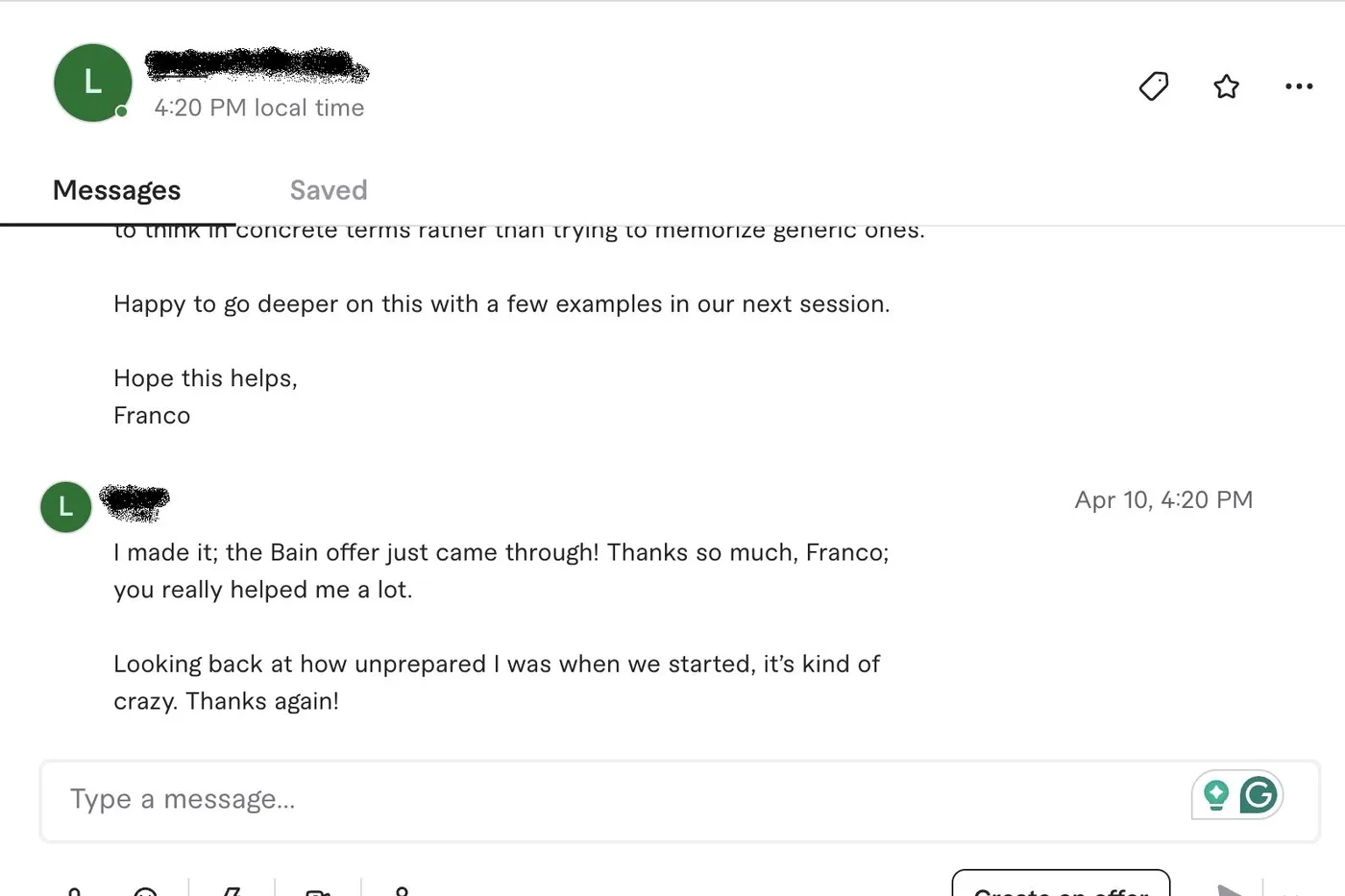
A candidate's reply to written feedback between sessions, later with a Bain offer. One candidate's experience; results depend on each candidate and process.
What you can and cannot expect
You can expect an honest assessment, specific priorities and a realistic interview experience. You cannot expect a guaranteed result: the decision depends on your performance on the day, on the interviewers and on how many people the office is hiring. Coaching improves your preparation; it does not control the outcome.
How many sessions you need
There is no reliable number in advance, because it depends on your starting point, the time you can practise and how fast you apply feedback. A sensible approach is to start with one session, use the diagnosis to decide, and add sessions only if they help.
| Your situation | Typical choice |
|---|---|
| You want a diagnosis, or have one specific interview coming up | 1 session |
| You want to practise, apply feedback and check progress | 3 sessions |
| You need to work on both case and fit, with support between sessions | 5 sessions |
| You are preparing for several firms or several interview stages | 10 sessions |
Space the sessions so that you have time to practise between them: often one a week, or every few days when interviews are close. A session the day after the previous one rarely shows progress, because there has been no time to act on the feedback.
Packages, prices and guarantee
All options include direct sessions with Franco and a written report after every session. Prices are in US dollars, as published on the coaching page on 2 November 2026.
| Package | Price | Per session | Best for |
|---|---|---|---|
| 1 session | US$249 | US$249 | Finding your main gaps or preparing for a specific interview |
| 3 sessions | US$669 | US$223 | Practising, applying feedback and reviewing progress |
| 5 sessions (recommended) | US$1,089 | US$218 | Working across case and fit skills with support between sessions |
| 10 sessions | US$2,119 | US$212 | Preparing across several firms and interview stages |
- Every package: one-to-one sessions with Franco and a written report after each session.
- From 3 sessions: a progress dashboard that brings your reports together, targeted self-practice materials and email support between sessions.
- 5 and 10 sessions: payment in instalments is available.
- Start small: you can start with one session and upgrade to a package later at the package price.
The guarantee
Coaching comes with a satisfaction guarantee: if the coaching does not meet your expectations, you get a full refund. It is a guarantee on the quality of the coaching, not on the result of your interviews.
Results so far
Candidates coached by Franco have received more than 100 offers from MBB firms, and the success rate is around 90%.1 These figures describe the outcomes of past coaching candidates.
1 Calculated on candidates with at least 5 sessions, the minimum to claim meaningful coaching impact.
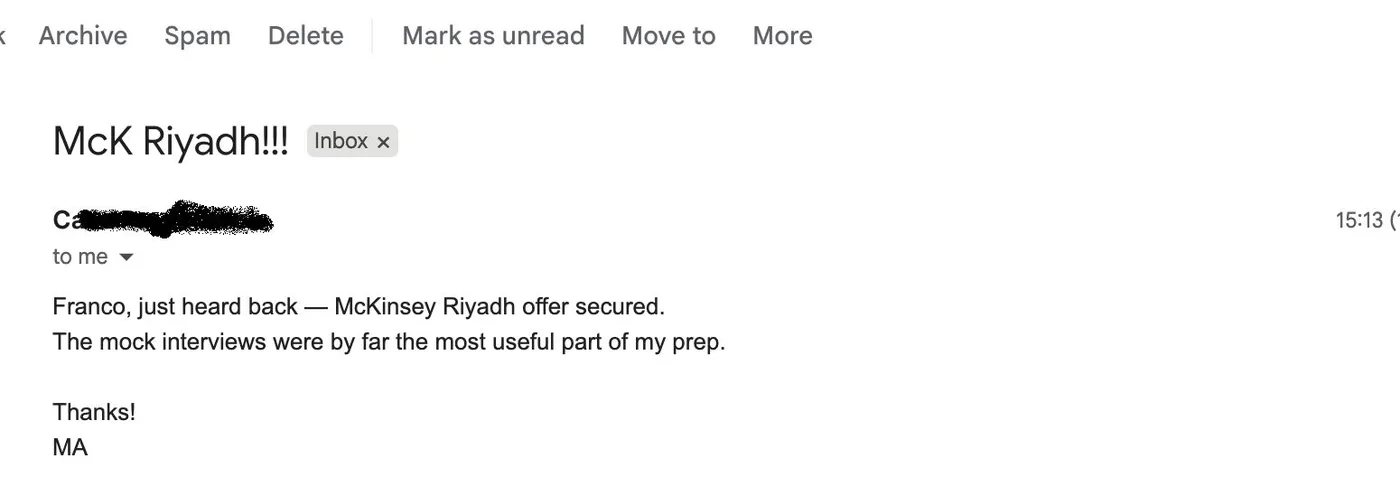
M.A., after a series of mock interviews, with a McKinsey Riyadh offer. One candidate's experience; results depend on each candidate and process.
1:1 interview coaching
Practise with a former BCG Principal and know exactly what to fix next
A realistic interview, a debrief and a written report after every session, all directly with Franco. Start with one session, or choose a package if you already know you need more practice.
- 1 session US$249; packages of 3, 5 or 10 sessions from US$212 per session
- Dashboard, practice materials and email support from 3 sessions
- Full refund if the coaching does not meet your expectations
Not sure yet? Send Franco a message with your target firms, dates and where you feel stuck.
Your first step
The simplest first step is a short message to Franco. It takes five minutes and gives him what he needs to tell you whether coaching makes sense for you, and if so, how to start. Include four things: your background in one or two lines, your target firms and offices, your interview dates or application deadlines, and where you feel stuck.
The message
"Hi Franco, I'm finishing a master's in finance and applying to BCG and Bain in London. My BCG first round is on 20 November; Bain hasn't scheduled yet. I've done about 15 cases with peers. My maths is fine, but I'm told my structures are too generic and I often wait for the interviewer to tell me what to do next. Is one session useful at this stage, or should I practise more first?"
Why it works
It gives the firms and dates, a sense of how much practice has been done, and a specific difficulty in the candidate's own words. That is enough to suggest whether to start now, what the first session should cover and how many sessions might make sense.
If you have already decided to coach and want to choose between packages, the free 15-minute call is the place to talk it through with Franco before booking.
Frequently asked questions
Is case interview coaching worth it?
Coaching is useful when you need a diagnosis, clearer priorities or a realistic rehearsal before an important round. Arrive familiar with the basic format and leave time to apply the feedback. If you already perform well, use the session to test your remaining gaps and your target firm's format.
When should I book my first session?
After you understand the format and have tried a few cases, but early enough to act on the feedback: ideally three to six weeks before your interviews. If your interview is in a few days, one realistic rehearsal can still help.
Can coaching help with fit and the McKinsey PEI?
Yes. Sessions can cover fit questions, your "why consulting" and "why this firm", and McKinsey Personal Experience Interview stories, with follow-up questions at the depth a real interviewer would go.
Is coaching useful for experienced hires?
Yes, often more so, because the bar on business judgement is higher and habits from other industries can work against you in a case. Coaching helps you lead the case from the top and keep answers concise.
Do I still need to practise with other candidates?
Yes. Peer practice should remain most of your live cases. Coaching tells you what to work on; practice with others is where you build the volume.
Will coaching guarantee me an offer?
No. No coach can guarantee an offer. The decision depends on your performance on the day and on factors outside your control. What coaching can do is make your preparation more targeted and realistic.
Your next step
Start with a session that shows where you stand and gives you clear priorities. Tell Franco your target firms, interview dates and current difficulties, so the practice can focus on what matters for your next round.
Coaching with Franco
Tell Franco where you stand
Send your target firms, interview dates and where you feel stuck. You will get a personal reply about whether and how to start.
Prefer to write first? Send Franco a message. The free call is for candidates choosing between packages.

About Franco
Franco Borgonovo
Former BCG Principal · 10-year tenure · Official BCG coachFranco spent ten years at BCG, from intern to Principal, interviewing and selecting candidates as a global lead recruiter. He is still an official BCG coach for new hires, and today works one to one with candidates on applications, McKinsey Solve and interviews.
More about Franco →